Wednesday, 19 August 2026
For a procurement or sourcing manager evaluating a new engine parts manufacturer for OEM supply, the stakes are higher than for most commodity buys. Engine components sit closer to a vehicle's safety and performance envelope than many other sheet-metal parts — a mounting bracket that fatigues, an oil sump that weeps, or a heat shield that fails under thermal cycling can surface as a warranty claim, a field failure, or a stopped assembly line long after the purchase order is closed. Yet many sourcing teams still default to a generic supplier scorecard built for low-risk, low-consequence commodities. This guide sets out a practical, engine-parts-specific framework — the certifications, capability checks and red flags — that OEM and Tier-1 sourcing teams should apply before awarding a new engine components program to an engine parts manufacturer in India or elsewhere.
Why Engine Parts Sourcing Deserves Extra Scrutiny
Engine components operate under continuous heat, vibration and pressure cycling for the vehicle's entire service life — very different demands from a static interior bracket or a low-load body panel. A dimensional deviation of a few tenths of a millimetre on a mounting bracket or timing cover can translate into a misaligned assembly, a vibration-induced fatigue crack, or a coolant and oil leak thousands of kilometres into a vehicle's life. That is why tolerances, metallurgy, weld integrity and surface treatment all carry more weight in an engine-parts qualification audit than they might in a general stamped-parts review — and why a manufacturer's specific engine parts track record deserves more scrutiny than a broad capability statement.
The 8-Point Evaluation Checklist for an OEM Engine Parts Supplier
Use this checklist as a working audit framework when shortlisting or re-qualifying an engine components vendor:
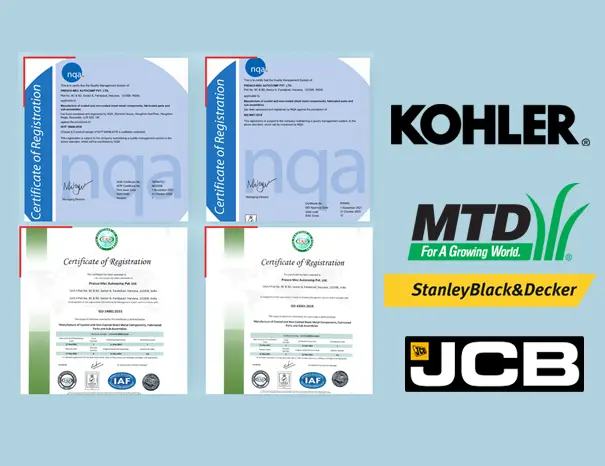
- Automotive-specific quality certification. A generic ISO 9001:2015 certificate is a baseline, not a differentiator. Confirm current IATF 16949:2016 certification specifically — this is the automotive sector standard that governs process control, PPAP and defect-prevention discipline for engine-critical parts.
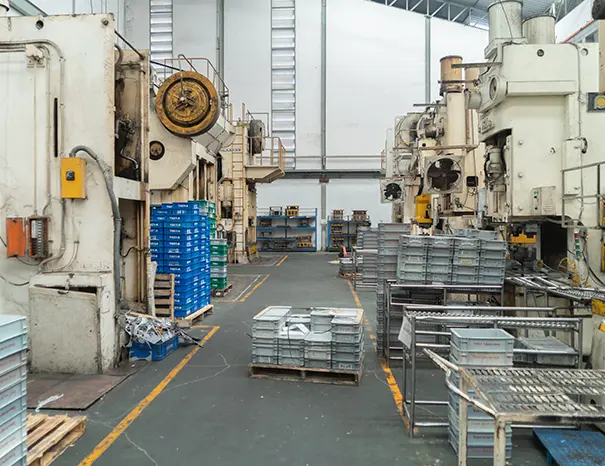
- In-house tooling and press capacity. Ask for actual press count and tonnage range, not just "high capacity" marketing language. A manufacturer running a broad tonnage band (from light stamping up to 400-ton presses) across dozens of machines can flex between prototype tooling and high-volume series production without subcontracting the press operation.
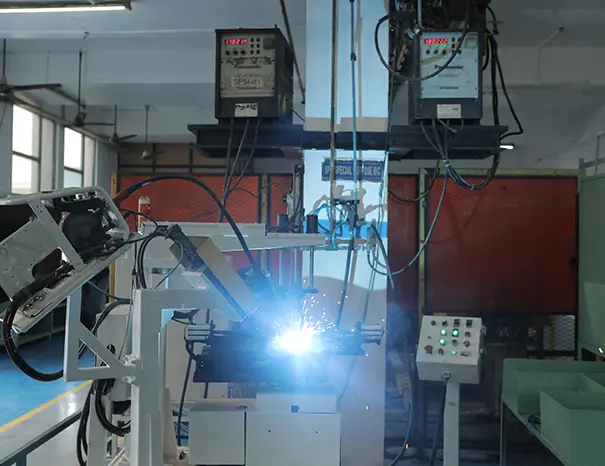
- Welding capability matched to your assembly. Engine sub-assemblies (mounting brackets, welded covers, sump assemblies) need process-appropriate joining — MIG, robotic, spot or projection welding — with repeatability built in through purpose-built SPMs (special purpose machines), not manual welding alone.
- Surface treatment kept in-house. Engine parts face heat and under-bonnet corrosion exposure. A supplier with an in-house PTCED (cathode electro-deposition) line and powder-coating capability controls finish quality and lead time directly, instead of routing parts to a third-party coater and losing traceability.
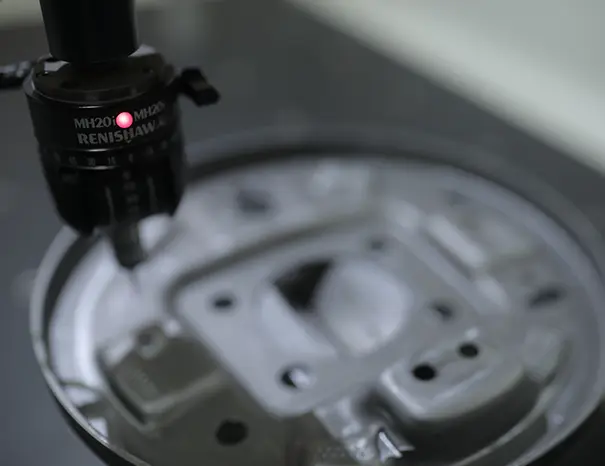
- Depth of metrology and inspection. Ask what's actually on the standard-room floor: Coordinate Measuring Machines (CMM), profile projectors and portable measuring arms (Faro Arm) indicate a supplier that can prove dimensional conformance batch after batch, not just claim it.
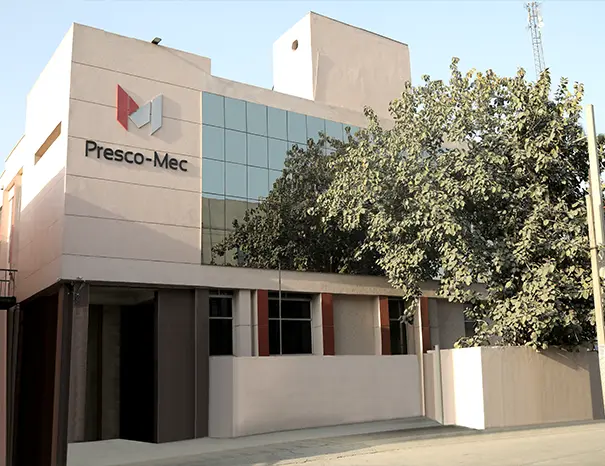
- Manufacturing footprint and warehouse network. Plant location and a pan-India (or regional) warehouse network close to your assembly plants materially affect just-in-time delivery reliability and freight cost — ask for actual plant addresses and warehouse cities, not "nationwide coverage."
- Independent vendor verification. A registered D&B D-U-N-S® number gives procurement and finance teams a fast, independent way to verify business legitimacy, credit standing and corporate structure during vendor onboarding — increasingly expected in structured OEM sourcing processes.
- Track record with comparable OEMs. Years in business, named OEM/Tier-1 customers, and supplier-performance awards (on-time delivery, quality) are a faster signal of execution reliability than a capability deck alone — ask for references from customers running similar volumes.
Red Flags That Should Slow Down a Sourcing Decision
A few warning signs are worth probing before a program is awarded, not after:
- ISO 9001:2015 certification only, with no IATF 16949:2016 — a signal the supplier may not be built for automotive-grade process control.
- Welding, coating or inspection routed to third parties with no visibility into that partner's own quality system.
- No willingness to share CMM reports, PPAP documentation, or a physical/virtual plant walkthrough before award.
- Vague answers on plant address, unit count, or warehouse locations — specifics that a genuine manufacturer will state plainly.
- A sourcing pitch built entirely around price, with no discussion of tooling ownership, capacity headroom, or contingency planning for volume spikes.
How We Qualify a New Engine Bracket Program
A new engine bracket program moves through a controlled qualification process to confirm manufacturability, dimensional accuracy and production readiness before series production begins.
1. Drawing Review
Review component drawings, material specifications, tolerances and critical characteristics for manufacturability.
2. Tooling
Develop and validate the required stamping tools and production fixtures based on the approved design.
3. Press Trial
Conduct press trials to verify forming performance, dimensional stability and process capability.
4. PPAP
Complete the required Production Part Approval Process documentation and submit samples for customer approval.
5. CMM Sign-Off
Verify critical dimensions using CMM inspection and confirm that the approved part meets drawing requirements.
One Vendor, Multiple Commodities: A Question Worth Asking
Many OEM procurement teams source brake parts, chassis and cabin parts, engine parts and two-wheeler parts from separate vendors by default. It's worth asking whether that's necessary. A single IATF 16949:2016-certified manufacturer capable of supplying brake parts, chassis & cabin parts and engine parts under one quality system reduces the number of supplier audits, PPAP cycles and vendor codes a sourcing team has to maintain — without necessarily concentrating commercial risk, since each commodity can still run its own tooling, purchase order and delivery schedule. For OEMs evaluating India as a sourcing destination, understanding India's chassis and cabin parts manufacturing capabilities can also provide useful context on the country's automotive supplier ecosystem and production capabilities.
How Presco-Mec Group Measures Up Against This Checklist
Presco-Mec Group has manufactured precision sheet-metal engine components for automotive OEMs and Tier-1s for more than 38 years, from two IATF 16949:2016 and ISO-certified manufacturing units in Faridabad, Haryana. Our press shop runs 30 presses up to 400-ton capacity, supported by MIG, robotic, spot and projection welding cells, an in-house PTCED and powder-coating line, and a standard room equipped with Coordinate Measuring Machines, profile projectors and Faro Arm metrology. We are D&B D-U-N-S® registered (65-006-5357) for fast vendor verification, supply from warehouses in Pithampur, Jamshedpur, Pune and Chennai alongside our Faridabad plants, and have been recognised with supplier excellence and best-supplier awards from OEM customers including Brakes India. For sourcing teams evaluating an engine parts supplier in India against the checklist above, our engine parts page and Quality Profile document each of these capabilities in more detail.
Start a Sourcing Conversation
If you're currently shortlisting an engine parts manufacturer for OEM supply, share your drawings, annual volumes and target timelines with our engineering team through our Business Enquiry page, and we'll come back with a feasibility response.
FAQs
Start with current IATF 16949:2016 certification, the automotive-specific quality standard, rather than ISO 9001:2015 alone. Also check ISO 14001:2015 (environmental) and ISO 45001:2018 (occupational health and safety) as supporting indicators of a mature, audited manufacturing system.
Ask for the actual number of presses and their tonnage range, not general capacity claims. A supplier running a wide tonnage band across dozens of presses, with an in-house tool room for design and development, can typically handle both prototype tooling and high-volume series production without subcontracting.
Engine components face heat and under-bonnet corrosion exposure, so finish quality directly affects service life. A manufacturer with an in-house PTCED (cathode electro-deposition) line and powder-coating capability controls both quality and traceability, rather than routing parts through a third-party coater.
Watch for ISO 9001:2015 certification without IATF 16949:2016, welding or coating outsourced with no visibility into that partner's quality system, reluctance to share CMM or PPAP documentation, and vague answers about plant address or warehouse locations.
It directly affects just-in-time delivery reliability and freight cost. Ask for actual plant addresses and warehouse cities near your assembly plants rather than a general "nationwide coverage" claim, and confirm lead times against your production schedule.
A single IATF 16949:2016-certified manufacturer able to supply brake parts, chassis and cabin parts, and engine parts under one quality system reduces the number of supplier audits and PPAP cycles a sourcing team has to manage, while each commodity can still run on its own tooling and delivery schedule.
Check for a registered D&B D-U-N-S® number, which gives procurement and finance teams an independent way to confirm business legitimacy, credit standing and corporate structure. Combine this with a plant visit or virtual audit and reference checks with comparable OEM customers.
About the Author
This post was reviewed by Sunil Goyal, Chief Operating Officer, Presco-Mec Group. Sunil brings 28 years of experience in supply chain management and international marketing, including prior roles with Tata, Eicher, Airtel and the Hero Group, and works closely with Presco-Mec's engineering and tool room teams on process capability for OEM and Tier-1 sourcing programs. Connect on LinkedIn: https://www.linkedin.com/in/sunil-goyal-1796442b/
For inquiries, you can reach Presco-Mec Group through the website www.prescomecgroup.com, via email at info@prescomecgroup.com , or on WhatsApp at +91 89299 81200 to discuss your requirements.
Published: 19 August 2026